


How to Choose the Right Software Development Company in Thiruvalla for Your Business
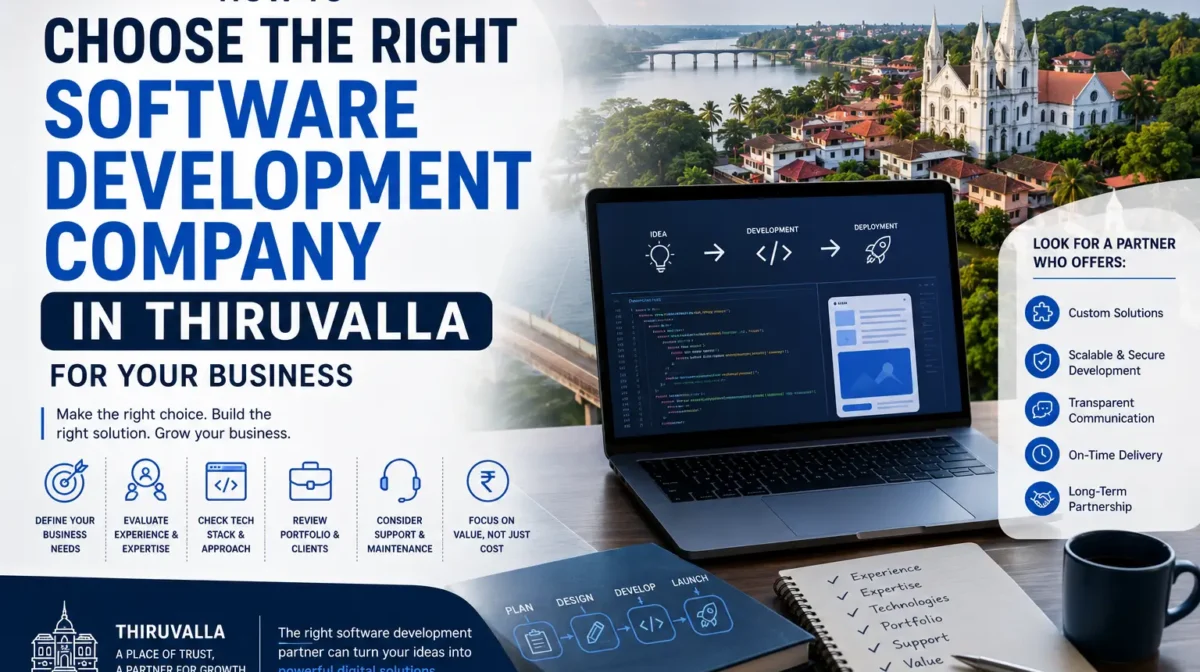
Choosing the right software development company in Thiruvalla should not be based only on price, team size, or how impressive the company website looks. The best development partner is one that understands your business problem, has relevant technical experience, follows a transparent development process, communicates clearly, protects your data and source code, and can support the software after launch.
For businesses in Thiruvalla and nearby areas, working with a local development company can also make requirement discussions, meetings, and long-term collaboration easier. However, location should be only one part of the decision. Technical capability, reliability, project ownership, security, testing, and post-launch support matter much more.
This guide explains what businesses should evaluate before selecting a software development partner.
What Should You Look for When Choosing a Software Development Company in Thiruvalla?
Look for a company that demonstrates relevant project experience, suitable technical skills, a structured development process, transparent pricing, clear communication, strong testing practices, and reliable post-launch support. The company should understand your business objective before recommending technologies or giving a final estimate.
A good development company should be able to explain not only what it can build, but also why a particular solution is appropriate for your business.
For example, imagine a distribution business that wants custom software for inventory, sales, invoicing, and reporting. One developer may immediately suggest building a large ERP platform. Another may first study the existing workflow and recommend starting with inventory and order management before expanding.
The second approach may reduce both cost and implementation risk.
Before hiring, evaluate five broad areas:
- Business understanding and requirement analysis
- Relevant development experience
- Technical capability
- Development and communication process
- Long-term support and ownership terms
Businesses exploring a local technology partner can also review the services and capabilities presented on the Signefo website as part of their vendor-comparison process.
How Can You Evaluate Experience, Technical Expertise, and Portfolio?
Do not judge experience only by the number of years a company has existed. Examine whether it has solved problems similar to yours, what technologies were used, what role the team actually played, and whether the delivered software is comparable in complexity to your proposed project.
Start with the portfolio.
Instead of simply asking, “Have you developed mobile apps?”, ask whether the company has developed applications involving features relevant to your requirements.
For example, if you need an appointment-booking platform, relevant experience could include:
user authentication,
online payments,
calendar integrations,
notifications,
admin dashboards,
role-based access, and
reporting.
A portfolio containing twenty basic websites may not prove that a team can successfully develop a complex SaaS application.
Ask the company to explain one or two previous projects in detail. A capable team should be able to discuss the problem, architecture, technologies, challenges, testing approach, deployment, and final outcome without relying only on screenshots.
Technical expertise should also match the project. Depending on what you are building, this could include frontend frameworks, backend technologies, mobile development, APIs, databases, cloud infrastructure, AI integrations, DevOps, cybersecurity, or third-party system integrations.
What Questions Should You Ask Before Starting Your Project?
A good vendor-selection conversation should reveal how the development team thinks, not simply produce a quotation.
Useful questions include:
- Have you built a similar product or business system before?
- Who will actually work on my project?
- How will you convert my business requirements into technical specifications?
- What technology stack do you recommend, and why?
- How will changes to scope affect cost and timelines?
- How frequently will I receive progress updates?
- Who owns the source code after payment?
- How will testing and security be handled?
- What happens if the project runs behind schedule?
- What support is available after launch?
- How are bugs distinguished from new feature requests?
- Where will the source code and documentation be stored?
Pay particular attention to how the company answers.
A trustworthy development partner should be comfortable discussing limitations, assumptions, risks, and alternatives. Be cautious when every question receives an immediate “yes” without any technical or business discussion.
Should You Choose a Local Software Company in Thiruvalla or a Remote Team?
A local software development company can be beneficial when your project requires frequent discussions, on-site understanding, local business knowledge, or long-term collaboration. A remote team can provide access to a wider talent pool. The better choice ultimately depends on communication quality, expertise, cost, and project requirements rather than location alone.
For businesses in Thiruvalla, a local team may make requirement workshops and face-to-face meetings easier.
This can be useful for software that depends heavily on existing offline workflows. A development team working on hospital software, retail systems, manufacturing applications, or internal business automation may benefit from observing how employees actually perform their work.
Remote development can work equally well when requirements are documented clearly and communication is structured.
For example, a SaaS startup might work effectively with developers located anywhere if it has:
clear product documentation,
weekly sprint meetings,
issue-tracking software,
shared design files, and
transparent code repositories.
Do not choose a Thiruvalla company simply because it is nearby. Choose it when local accessibility plus technical competence creates a genuine business advantage.
How Much Does Custom Software Development Cost?
There is no fixed price for custom software development because cost depends on scope, complexity, design, integrations, security requirements, development time, team composition, infrastructure, testing, and ongoing maintenance. A simple internal application may cost far less than a multi-user SaaS, ERP, marketplace, or enterprise platform.
Rather than asking for a generic “software development price,” define what needs to be built.
For example, consider two projects.
Project A: Employee leave-management application with login, leave requests, approvals, and basic reports.
Project B: Multi-company HR platform with payroll, attendance integrations, mobile apps, analytics, permissions, payment subscriptions, and third-party APIs.
Both could be described as “HR software,” but their development effort would be dramatically different.
According to Clutch’s 2026 guidance on software-development budgeting, factors such as software complexity, security, UX/UI design, frontend features, backend infrastructure, development methodology, and team location can all influence cost. It also recommends budgeting for testing, multiple iterations, launch, and ongoing maintenance rather than development alone.
A useful quotation should therefore separate, where applicable:
Discovery → UI/UX → Development → Testing → Deployment → Infrastructure → Maintenance
Be cautious of unusually low fixed quotes provided before the company understands your requirements.
How Do You Evaluate Development Process and Project Management?
A professional development company should have a defined process for gathering requirements, designing the solution, developing features, testing, getting client feedback, deploying the software, and supporting it after release. You should know how progress will be tracked before development begins.
Many teams work in iterations or sprints rather than disappearing for several months and presenting the completed software at the end.
For a three-month project, for example, you might expect:
requirements and planning first,
then UI/UX or prototypes,
followed by feature development,
regular demonstrations,
testing,
user acceptance testing,
and final deployment.
Clutch’s current software-development budgeting guidance describes analysis and planning, requirements, design/prototyping, development, testing, launch, and maintenance as common parts of the software development lifecycle.
Ask what project-management system will be used and how frequently you can see progress.
You should ideally have visibility into:
current tasks,
completed features,
pending decisions,
bugs,
timeline risks, and
upcoming releases.
Good communication does not mean having daily meetings. It means receiving predictable updates and knowing who is responsible when a decision is needed.
How Should You Evaluate Delivery Timelines?
A timeline should be based on project scope rather than what the client wants to hear.
If one company estimates four months and another promises the same complex product in four weeks, investigate the difference.
Ask whether the timeline includes:
requirement gathering,
design,
development,
QA testing,
client testing,
bug fixing,
deployment,
and contingency for revisions.
Also ask what can cause delays.
Client-side delays matter too. Late approvals, changing requirements, unavailable API access, and delayed content or data can extend schedules even when the development team is performing well.
A useful agreement should therefore define responsibilities on both sides.
What Should You Check About Software Security?
Security should be part of the software development lifecycle rather than something added after development. Ask how the company handles authentication, permissions, sensitive data, encryption, dependency vulnerabilities, secure coding, backups, logging, and security testing.
This becomes especially important for systems handling customer data, financial information, healthcare information, employee records, or payments.
OWASP recommends integrating secure coding practices into the development lifecycle and treating security as part of development rather than waiting until the end of a project.
For a useful independent reference, businesses can review the OWASP Secure Coding Practices guidance.
You do not necessarily need to understand every technical security term. What matters is whether the development company has a clear process and can explain it.
What Should You Check About Scalability?
Scalability means more than saying, “The software can handle more users.”
Ask what happens if:
500 users become 50,000,
the amount of stored data increases dramatically,
you add another branch,
you introduce a mobile application,
or new third-party integrations are required.
Not every small application needs expensive enterprise architecture from day one. Overengineering can waste money.
A competent software partner should build for your realistic growth expectations while avoiding unnecessary complexity.
Who Should Own the Source Code?
Source-code ownership should be defined in writing before development begins. Businesses commissioning custom software should clearly understand who owns the code, database structure, designs, documentation, domains, cloud accounts, and other project assets after agreed payments are completed.
Do not assume ownership automatically.
The contract should explain whether:
the customer receives full ownership,
the company retains reusable components,
third-party/open-source components are used,
and whether there are licensing restrictions.
Ideally, source code should be stored in a version-control repository with appropriate access rather than existing only on a developer’s personal computer.
This becomes critical if you need another development team in the future.
What Should You Check About Testing, Maintenance, and Support?
Testing should happen throughout development, not only immediately before launch.
Depending on the software, testing may include:
functional testing,
device/browser testing,
API testing,
performance testing,
security testing,
automated testing,
and user acceptance testing.
Before signing a contract, clarify what happens after launch.
Ask how long bug-fix support is included, what constitutes a bug, what maintenance plans cost, what the response time is for critical issues, and whether the company can continue developing new features.
Software is rarely “finished forever.” Operating systems, browser versions, APIs, security requirements, and business requirements all change.
What Red Flags Should Businesses Watch for?
Several warning signs should make you investigate further before hiring a software company.
Promises of an exact price and deadline before requirements are understood are one concern. Others include unclear contracts, reluctance to discuss source-code ownership, no identifiable development process, vague portfolio descriptions, poor communication during the sales stage, no testing plan, dependence on a single developer without contingency, and extremely low quotations compared with competing proposals.
Another red flag is a company that agrees to every feature without questioning whether those features are actually necessary.
A good software partner should occasionally challenge your assumptions.
For example, if you request ten features for the first launch but only four are needed to validate the product, suggesting an MVP may save months of development and reduce risk.
A Practical Software Development Company Evaluation Checklist
| Area | What to Verify |
|---|---|
| Business understanding | Does the team understand the problem before proposing technology? |
| Portfolio | Are previous projects relevant in complexity or functionality? |
| Technical expertise | Does the stack match your requirements? |
| Requirements | Is scope documented clearly? |
| Process | Are development stages and approvals defined? |
| Communication | Is there a dedicated contact and update schedule? |
| Timeline | Is the estimate realistic and milestone-based? |
| Testing | Are QA and acceptance procedures defined? |
| Security | Is security integrated into development? |
| Scalability | Can the architecture support realistic future growth? |
| Source code | Are ownership and repository access documented? |
| Support | Are maintenance terms and response times clear? |
| Pricing | Are inclusions, exclusions, and change requests transparent? |
Final Thoughts
Choosing the right software development company in Thiruvalla requires more than comparing quotations.
Start by clearly defining the business problem you want the software to solve. Then evaluate whether the development company has relevant experience, the required technical skills, a transparent development process, reliable communication, strong testing and security practices, clear source-code ownership terms, and the ability to support the product after launch.
A simple selection process is:
Define requirements → shortlist companies → review relevant work → discuss technical approach → evaluate process → compare proposals → verify ownership and support → start with clear milestones.
A local company can offer convenient collaboration and easier access for businesses in Thiruvalla, but technical capability and long-term reliability should remain the deciding factors.
The lowest quotation is rarely automatically the best choice. The goal is to select a development partner capable of delivering software that works reliably today and remains maintainable as your business grows.
Frequently Asked Questions
How do I choose the best software development company in Thiruvalla?
Compare companies based on relevant project experience, technical skills, development process, communication, testing, security, pricing transparency, source-code ownership, and post-launch support rather than choosing only by cost.
Should I hire a local software developer or outsource my project?
A local company can be useful for face-to-face collaboration and understanding local business workflows. Remote teams may offer a larger talent pool. Either model can work if expertise, communication, accountability, and project management are strong.
How much does software development cost in Thiruvalla?
There is no standard price. Cost depends on features, complexity, integrations, UI/UX, security, development hours, team size, infrastructure, testing, and maintenance. Request a detailed scope-based estimate rather than relying on a generic package price.
How long does custom software development take?
A basic application may require considerably less time than a complex SaaS, ERP, marketplace, or enterprise platform. Timelines should be determined only after requirements, features, integrations, testing needs, and deployment requirements are understood.
Should the customer own the software source code?
Ownership should be explicitly defined in the contract. Before starting development, clarify ownership of source code, designs, databases, documentation, cloud accounts, and any third-party components.
What support should a software company provide after launch?
Post-launch support may include bug fixing, monitoring, backups, security updates, performance improvements, software updates, and new feature development. Verify the included support period and ongoing maintenance charges before signing.
What is the biggest red flag when hiring a software development company?
One major warning sign is a company promising an unusually low price or very short deadline without first understanding the project’s requirements. Lack of clear ownership, testing, documentation, or communication processes are also significant concerns.
What should I prepare before contacting a software company?
Prepare a short description of the business problem, intended users, important features, existing systems that require integration, desired timeline, approximate budget, and future growth expectations. The development team can then help convert these requirements into a detailed project scope.
