


Brand Strategy for Startups: What to Define Before Launching Your Business
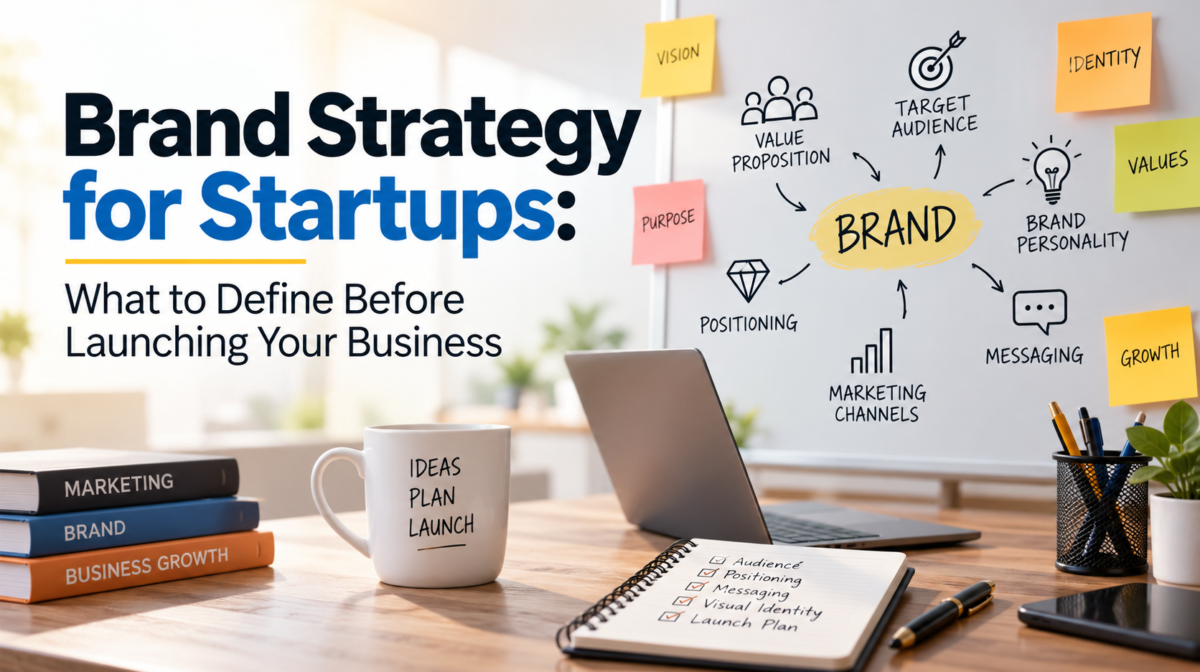
Launching a startup involves more than developing a product, choosing a company name or designing a logo. Before entering the market, founders need a clear brand strategy that explains who the business serves, what problem it solves, why customers should choose it and how it wants to be perceived.
A well-defined brand strategy helps startups communicate consistently across their website, social media, advertising, sales presentations and customer interactions. It also provides a foundation for visual identity, marketing messages and long-term positioning.
For early-stage businesses working with limited budgets, defining these fundamentals before launch can reduce inconsistent messaging and help marketing activities focus on the right audience.
This guide explains the key elements of brand strategy every startup should establish before launching its business.
What Is Brand Strategy, and Why Does a Startup Need It?
Brand strategy is a long-term plan for how a business positions itself in the market, communicates its value and builds relationships with its target customers.
It is broader than a logo, colour palette or advertising campaign. Those are ways of expressing a brand; strategy defines what the brand stands for and why it should matter to customers.
For example, two startups may sell similar project management software. One may position itself as an affordable, easy-to-use solution for small businesses, while the other focuses on advanced reporting and workflow automation for large enterprises.
Although their products may overlap, their target audiences, messaging, pricing and marketing approaches could be very different.
A clear brand strategy helps a startup:
-
Differentiate itself from competitors.
-
Identify and communicate its unique value.
-
Build a consistent brand identity.
-
Make marketing decisions more efficiently.
-
Create stronger customer recognition.
-
Establish a foundation for future growth.
Brand strategy does not guarantee business success, but it helps ensure that customers understand what the business offers and whom it is designed to serve.
1. Who Is Your Target Audience?
The first step in developing a brand strategy is identifying the people or businesses most likely to buy your product or service.
Trying to appeal to everyone can make a startup’s message too broad to be meaningful. A clearly defined audience helps the business prioritize product development, marketing channels and communication.
Start by identifying:
-
Age group, location or business category, where relevant.
-
Customer needs and pain points.
-
Buying motivations.
-
Budget and willingness to pay.
-
Common objections before purchasing.
-
Where potential customers research and compare options.
For a B2B startup, useful questions include the customer’s industry, company size, decision-making process and existing business challenges.
For a consumer startup, buying habits, lifestyle, preferences and purchasing triggers may be more relevant.
Create a simple customer profile
Imagine a startup offering digital accounting software. Its initial target audience might be small businesses that need straightforward invoicing and expense tracking without the complexity of enterprise software.
This profile is more useful than simply saying the product is for “business owners.”
Use customer interviews, surveys, existing sales data and competitor reviews to validate your assumptions. As the startup gains customers, refine the audience definition using actual buying behaviour.
2. What Problem Does Your Startup Solve?
A strong brand communicates a meaningful customer benefit rather than merely describing its product features.
Before launch, define the main problem your business solves and why that problem matters to your intended audience.
Ask:
-
What difficulty does the customer experience?
-
How do customers currently solve it?
-
What is frustrating or inadequate about existing options?
-
What measurable or practical improvement does your product offer?
-
Why would a customer act now rather than postpone the purchase?
For example, a startup selling appointment-booking software could describe its product as a scheduling platform. However, a more customer-focused explanation might emphasize reducing manual booking work and missed appointments.
The second approach connects the product to a business problem.
Avoid claiming that your product is faster, cheaper or more effective unless you have evidence to support the statement. A specific, credible benefit is more useful than a broad promise of being the best.
3. What Makes Your Brand Different From Competitors?
Brand positioning defines the place your startup wants to occupy in the customer’s mind relative to competing options.
Before launching, research direct competitors, indirect alternatives and the possibility that customers may continue using their existing method instead of buying your product.
Compare competitors based on:
-
Target audience.
-
Product or service offering.
-
Pricing and packaging.
-
Main benefits and limitations.
-
Brand messaging and tone.
-
Customer experience.
-
Reviews and recurring customer complaints.
The purpose is not to copy a successful competitor. It is to identify where your startup can offer a relevant and credible alternative.
For example, if competitors primarily target large companies with complex software, a new business might focus on simpler onboarding and support for smaller teams—provided its product can genuinely deliver those benefits.
A useful positioning statement follows this structure:
For [target audience], [brand name] is a [product or service category] that helps them [primary benefit] because [credible point of difference].
This statement gives founders a reference point for website copy, sales pitches and advertising.
4. What Should Your Brand Promise Be?
A brand promise describes the experience or benefit customers should consistently expect from your business.
It should be specific enough to guide decisions and realistic enough to deliver.
For a startup, the promise might focus on simplicity, responsive service, transparent pricing, specialized expertise or convenient access.
For example, a business promising “straightforward onboarding and clear pricing” must ensure that its onboarding process is genuinely easy to follow and its charges are clearly communicated.
Your brand promise should align with:
-
The actual product or service.
-
Your team’s capabilities.
-
Your customer support processes.
-
Your pricing model.
-
The experience you can maintain as the business grows.
Avoid promises that depend on factors outside your control. A startup cannot responsibly guarantee that every customer will achieve a particular financial result or experience a specific outcome.
The most effective promise is one the business can repeatedly support through its actions.
5. How Should You Define Your Brand Personality and Voice?
Brand personality describes the human qualities your business wants to communicate. Brand voice determines how those qualities appear in written and spoken communication.
A startup could aim to sound knowledgeable and professional, friendly and approachable, bold and energetic, or calm and reassuring.
The right approach depends on the target audience, category and customer expectations.
For example, a financial technology startup may prioritize clarity, trust and professionalism. A youth-focused lifestyle brand may use more informal and expressive language.
Define three to five characteristics that describe your desired voice. Then explain how they translate into communication.
| Brand Trait | How It Appears in Communication |
|---|---|
| Clear | Use straightforward language and explain technical terms |
| Helpful | Answer practical customer questions |
| Confident | Explain benefits without exaggerated claims |
| Approachable | Use natural, respectful language |
| Consistent | Maintain a recognizable tone across channels |
Create a short messaging guide with preferred terminology, phrases to avoid and examples of how to describe your product.
This becomes particularly useful when multiple employees, agencies or freelancers create content for the same brand.
6. What Should You Decide About Your Brand Name and Visual Identity?
Your brand name, logo, typography, colours and imagery influence how customers recognize and interpret your business. However, visual identity should reflect the positioning and personality defined earlier.
Before finalizing a name, check whether it is distinctive, pronounceable, appropriate for your audience and practical to use across digital channels.
Also investigate relevant trademark availability and domain-name options. A domain being available does not mean the name is legally available for use.
In India, founders can begin trademark research through the IP India Trade Marks Registry. Consider professional legal advice where the name is commercially important or potential conflicts exist.
Build a consistent visual identity
Your initial visual identity should generally include:
-
A primary logo and appropriate variations.
-
A defined colour palette.
-
Primary and secondary typography.
-
Guidelines for photography and illustrations.
-
Basic layouts for social media and presentations.
-
Website and digital design principles.
A startup does not necessarily need a complicated brand book at launch. A concise document with practical examples can help maintain consistency while keeping the process manageable.
The goal is not simply to make the brand look attractive. It is to create an identity that supports the intended positioning and works across the channels customers use.
7. How Should Your Brand Messaging Communicate Your Value?
Once the audience, positioning and brand promise are defined, translate them into messages customers can understand quickly.
Your core messaging should answer four questions:
-
What does the business offer?
-
Who is it for?
-
What important problem does it solve?
-
Why should customers consider it instead of alternatives?
These answers should be reflected in your homepage headline, product pages, social profiles, pitch deck and sales materials.
For example, a generic headline such as “Innovative Solutions for Modern Businesses” provides little information about what the startup actually does.
A more specific message—such as “Inventory software that helps independent retailers track stock and reduce manual reporting”—communicates the product, audience and practical benefit more clearly.
Use supporting proof where possible, including product demonstrations, transparent specifications, customer feedback obtained with permission and verifiable case studies.
If your startup is pre-launch and has no customer results yet, explain the product’s capabilities honestly rather than inventing testimonials or performance claims.
8. Which Marketing Channels Should Your Startup Prioritize?
Brand strategy should guide where and how you communicate, not just what you say.
A startup with a limited marketing budget should prioritize channels that match its audience’s behaviour and the complexity of its purchase.
Potential channels include:
-
Website: Explains the offer, builds credibility and supports enquiries or purchases.
-
Search engine optimization (SEO): Helps customers discover relevant pages through search engines.
-
Social media: Supports awareness, community engagement and distribution of useful content.
-
Email marketing: Enables follow-up with subscribers and prospective customers who have consented to receive communications.
-
Paid advertising: Tests audience response and captures demand when targeting and economics support it.
-
Partnerships and referrals: Help reach relevant audiences through trusted relationships.
You do not need to invest equally in every channel.
For example, a local service business may prioritize local search, customer reviews and referrals, while a specialist B2B software company may focus on educational content, demonstrations, professional networks and targeted outreach.
Choose a small number of priority channels, define what each should achieve and measure whether it contributes to meaningful business outcomes.
9. What Brand Strategy Documents Should Be Ready Before Launch?
You do not need a lengthy strategy document to launch effectively. A practical startup brand strategy can begin with a concise set of decisions that the team can refer to.
Your launch-ready brand brief should include:
-
Target audience: Who you want to reach first.
-
Customer problem: What need or challenge you address.
-
Positioning: How you want to be distinguished from alternatives.
-
Value proposition: The main benefit customers should understand.
-
Brand promise: What experience you intend to deliver consistently.
-
Brand personality and voice: How the business should communicate.
-
Visual identity: Logo, colours, typography and basic design rules.
-
Core messaging: Key statements for the website and marketing.
-
Channel priorities: Where you will focus initial marketing.
-
Measurement plan: How you will evaluate awareness, engagement and commercial results.
Set aside time to review these decisions after launch. Early customer feedback may reveal that your original audience definition, messaging or value proposition needs adjustment.
Brand strategy should provide direction without preventing the business from learning.
Common Brand Strategy Mistakes Startups Should Avoid
Some branding mistakes can make it harder for a new business to establish a clear market position.
Designing the logo before defining the strategy: Visual identity is more effective when it reflects the audience, positioning and brand personality.
Trying to target everyone: A broad audience definition can produce vague messages and inefficient marketing.
Copying competitors: Similar-looking brands can struggle to communicate a distinct reason to choose them.
Making unsupported claims: Promises such as “the best,” “guaranteed results” or “industry-leading” require appropriate evidence and context.
Inconsistent communication: Different messages across the website, advertisements and sales materials can confuse prospective customers.
Ignoring customer feedback: The brand’s intended image may differ from how customers actually perceive it.
Spending the entire budget on design: A polished identity matters, but the business also needs a functioning website, relevant messaging, customer research and a way to measure marketing performance.
Avoiding these mistakes does not require a large branding budget. It requires clear decisions and consistent execution.
Conclusion: Define Your Brand Before You Launch
A startup’s brand strategy should establish who the business serves, what problem it solves, how it differs from alternatives and what customers can reasonably expect from it.
These decisions create a foundation for the name, visual identity, messaging, website and marketing channels. They also help the team make consistent decisions as the business grows.
Before investing heavily in advertising or design, document your target audience, positioning, value proposition, brand promise, voice and launch priorities. Test these decisions with potential customers and refine them as evidence develops.
For businesses seeking help with brand positioning, visual identity, messaging and digital presence, Signefo can be a relevant starting point for exploring branding and business website requirements. Learn more at Signefo.
The objective is not to create a perfect brand before launch. It is to build a clear, credible and recognizable brand that customers can understand—and that the business can consistently deliver on.
Frequently Asked Questions
What is the first step in developing a brand strategy for a startup?
Start by identifying your target audience and the problem your business solves. These decisions guide positioning, messaging, visual identity and marketing priorities.
How much should a startup spend on branding?
There is no universal budget. Costs depend on whether the business needs strategy consulting, naming, trademark advice, visual identity, website design or ongoing marketing support. Prioritize the work required to communicate your offer clearly and establish a credible market presence.
Is a logo the same as a brand strategy?
No. A logo is one component of visual identity. Brand strategy defines the target audience, positioning, value proposition, brand promise and communication direction behind that identity.
Should a startup hire a branding agency before launch?
An agency may be useful when the founders need external research, strategic direction, naming, identity design or consistent brand implementation. The decision depends on the team’s capabilities, budget and business requirements.
How can a startup differentiate itself from established competitors?
Identify an underserved audience, an important customer problem or a benefit competitors do not communicate or deliver effectively. Validate that the proposed difference is relevant to customers and supported by the startup’s actual capabilities.
Can a startup change its brand strategy after launch?
Yes. Customer feedback, market changes and business performance may justify refining positioning or messaging. Changes should be based on evidence and implemented consistently rather than made simply to follow trends.
